Treat each check as answering a different question
Knowing who you are hiring, understanding their experience and checking relevant cover are separate tasks. A company number answers a different question from a current professional registration. A smart website answers neither by itself. Start with the business's full trading details and make sure the name on its quotation, invoice and supporting documents is understandable and consistent.
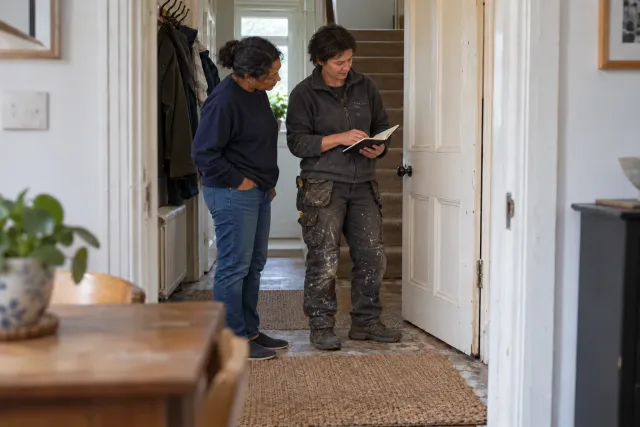
Ask who you would contract with and who would carry out the work. A business may use employees, subcontractors or another specialist for part of a project. There is no need to assume that this is a problem, but you should know who coordinates the work and who answers your questions. Record a reliable contact method and clarify any difference between a trading name and the legal entity.
Check a limited company using the official service
GOV.UK's company information service links to Companies House, where you can check details such as a company's registered address, status and filing history. Search using the company number supplied by the business where possible. A similar name alone may lead you to a different company.
Company registration is not proof that someone can carry out your particular job well. Equally, a sole trader is not necessarily a limited company, so an absence from that register does not by itself settle whether the business is genuine. Ask it to explain its business structure and provide clear written contact and contracting details. Look for answers that you can follow rather than collecting identifiers without understanding them.
Match qualifications to the work
Ask what registration or qualification is relevant to the task you are commissioning and how you can check it. Where a business displays a membership badge, visit the organisation's own website rather than relying on a screenshot of a certificate. Check the name, current status and scope of that membership.
For gas work, HSE points consumers to Gas Safe Register's engineer check. Use the engineer's licence details and check the relevant work categories. Gas registration is specific: do not assume that being registered means an engineer is qualified for every appliance or type of gas work. For other specialist work, ask the business which official or professional register is relevant and confirm the position for your UK nation and project.
- Which qualification or registration relates to this exact work?
- Can I confirm it with the issuing organisation?
- Does it cover the person who will attend?
- Will specialist work be completed by another business, and who arranges it?
Discuss insurance with the project in view
Ask for evidence of insurance relevant to the proposed work. Look at the insured business name, policy dates and description of activities. Ask the business to explain any mismatch or exclusion you do not understand. A photograph of a policy front page may not tell you whether the particular activity is covered, and having insurance does not promise that every loss will be paid.
Different projects raise different questions. If design work is part of the appointment, ask what cover relates to that responsibility. If several businesses will attend, ask how their insurance arrangements fit together. For advice about the adequacy of cover, use an appropriately qualified adviser or the relevant insurer. Avoid treating one headline level of cover as suitable for every job.
Ask how the work will be managed safely
HSE's domestic-client guidance encourages reasonable enquiries about a contractor's ability to manage health and safety, and allowing sufficient time and resources for safe work. In Great Britain, construction projects have duties under CDM 2015; the arrangements depend on the project. Read HSE's guidance and agree who manages coordination, especially where several contractors are involved. Northern Ireland has its own regulatory framework, so use the appropriate local guidance there.
You can make the conversation concrete: how will the work area be separated from your household, who controls access and what must be ready before the team starts? A tradesperson should be able to discuss the approach without asking you to diagnose technical risks. Save the checks with the agreed documents and revisit time-limited evidence if the start date moves.
Sources and further reading
Checked when this guide was prepared. Follow the relevant source for current requirements in your part of the UK.